
Objective Questions
Question 1
Write true or false for each statement:
(a) Equal volumes of two different substances have equal masses.
(b) The density of a piece of brass will change by changing its size or shape.
(c) The density of a liquid decreases with increase in its temperature.
(d) Relative density of water is 1.0.
(e) Relative density of a substance is expressed in g cm-3.
(f) When a body is immersed in a liquid, the buoyant force experienced by the body is equal to the volume of the liquid displaced by it.
(g) A body experiences the same buoyant force while floating in water or alcohol.
(h) A body experiences the same buoyant force when it floats or sinks in water.
(i) A body floats in a liquid when its weight becomes equal to the weight of the liquid displaced by its submerged part.
(j) A body while floating, sinks deeper in a liquid of low density than in a liquid of high density.
Answer
(a) False
Correct Statement — Equal volumes of two different substances have different masses.
(b) False
Correct Statement — The density of a piece of brass will not change by changing its size or shape.
(c) True
(d) True
(e) False
Correct Statement — Relative density has no unit.
(f) False
Correct Statement — When a body is immersed in a liquid, the buoyant force experienced by the body is equal to the weight of the liquid displaced by the immersed part of the body.
(g) True
(h) False
Correct Statement — The buoyant force experience by the body is different when floating or sinking in water.
(i) True
(j) True
Question 2
Fill in the blanks:
(a) 1 kg is the mass of …………… mL of water at 4°C.
(b) Mass = density x …………… .
(c) The S.I. unit of density is …………… .
(d) Density of water is …………… kg m-3.
(e) 1 g cm-3 = …………… kg m-3.
(f) The density of a body which sinks in water is …………… than 1000 kg m-3.
(g) A body sinks in a liquid A, but floats in a liquid B. The density of liquid A is …………… than the density of liquid B.
(h) A body X sinks in water, but a body Y floats on water. The density of the body X is …………… than the density of body Y.
(i) The buoyant force experienced by a body when floating in salt-water is …………… that when floating in pure water.
(j) The weight of a body floating in a liquid is …………… .
Answer
(a) 1000
(b) volume
(c) kg m-3
(d) 1000
(e) 1000
(f) more
(g) less
(h) more
(i) equal to
(j) zero
Question 3:
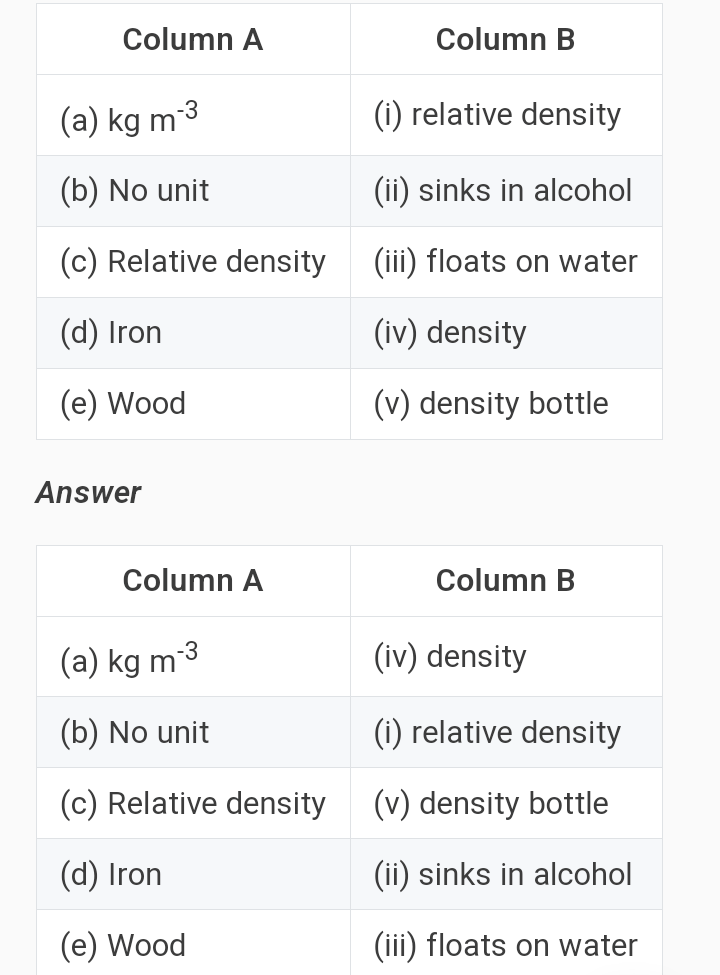
Match the following:
ICSE Physics Class 8 Notes Chapter 2 Physical Quantities and Measurement
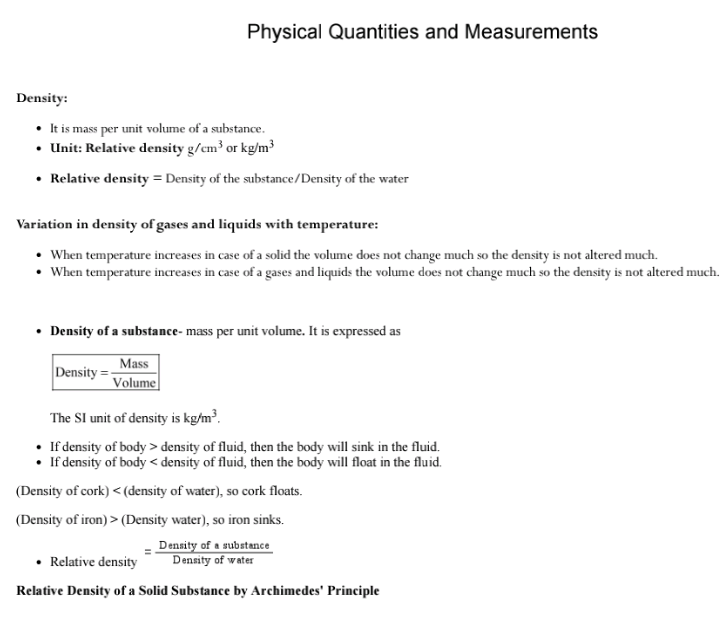
→ MASS : Is the quantity of matter contained in a body.
VOLUME : is the space occupied by body.
→ Equal mass of IRON and cotton, iron will have less volume than cotton.
→ Equal volume of Iron and cotton, the mass of iron is more than mass of cotton, because iron denser than cotton.
→ DENSITY : “Is ratio of mass of substance to volume of M kg substance”
D = MV = kgm3 The SI. unit of density is kg m-3
→ Density of a substance does not change with change in shape or size.
→ When a substance is heated it expands and volume increases. Hence density decreases. Water has maximum density at 4°C i.e. density of water increases from 0°C to 4°C and decreases above 4°C.
→ Volume of substance is measured by formula V = L x B x H or 43πr3or by measuring cylinder.
→ Mass is measured by beam balance or spring balance.
→ RELATIVE DENSITY : of substance is the density compared with water i.e. How many times the substance is DENSER than water. Since density of water is 1 gem-3, the density of a substance in g cm-3 = relative den.c ‘ty of substance.
S.I. unit of R.D → has no units → Since it is the ratio of the same quantities.
→ If a substance has density more than liquid it SINKS in the liquid and if the density of substance is LESS than liquid it floats on liquid.
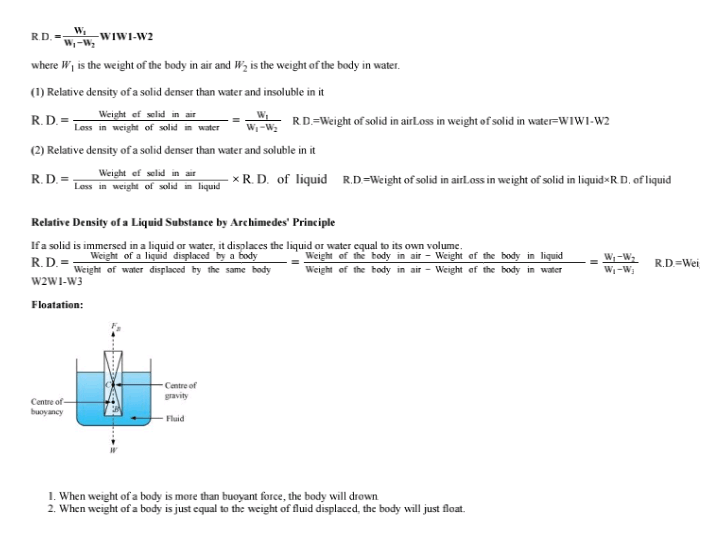
→ BUOYANT FORCE : “The force exerted by liquid acting vertically upward on a body and is equal to the weight of liquid displaced by its immersed part.”
→ Weight of body: Acting vertically downward. This force has the tendency to sink the body.
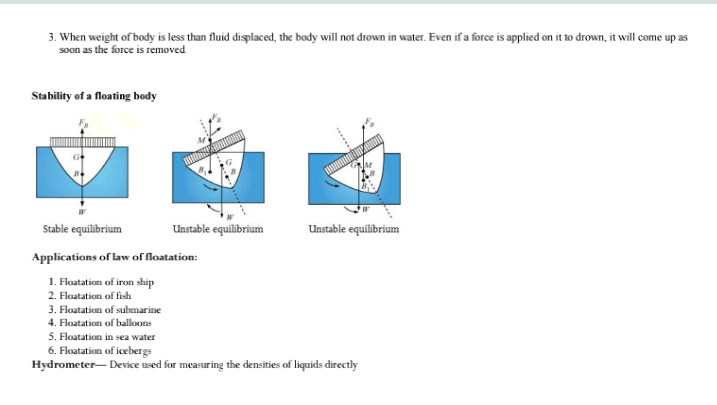
→ LAW OF FLOATATION : “When a body floats in a liquid, the weight of the liquid displaced by its immersed part is equal to the total weight of the body.”
While floating wt. of floating body W = wt. of liquid displaced by its immersed part FB i.e. Apparent wt. of floating
body is zero.
Copyright is strictly forbidden..
 Lavender.in